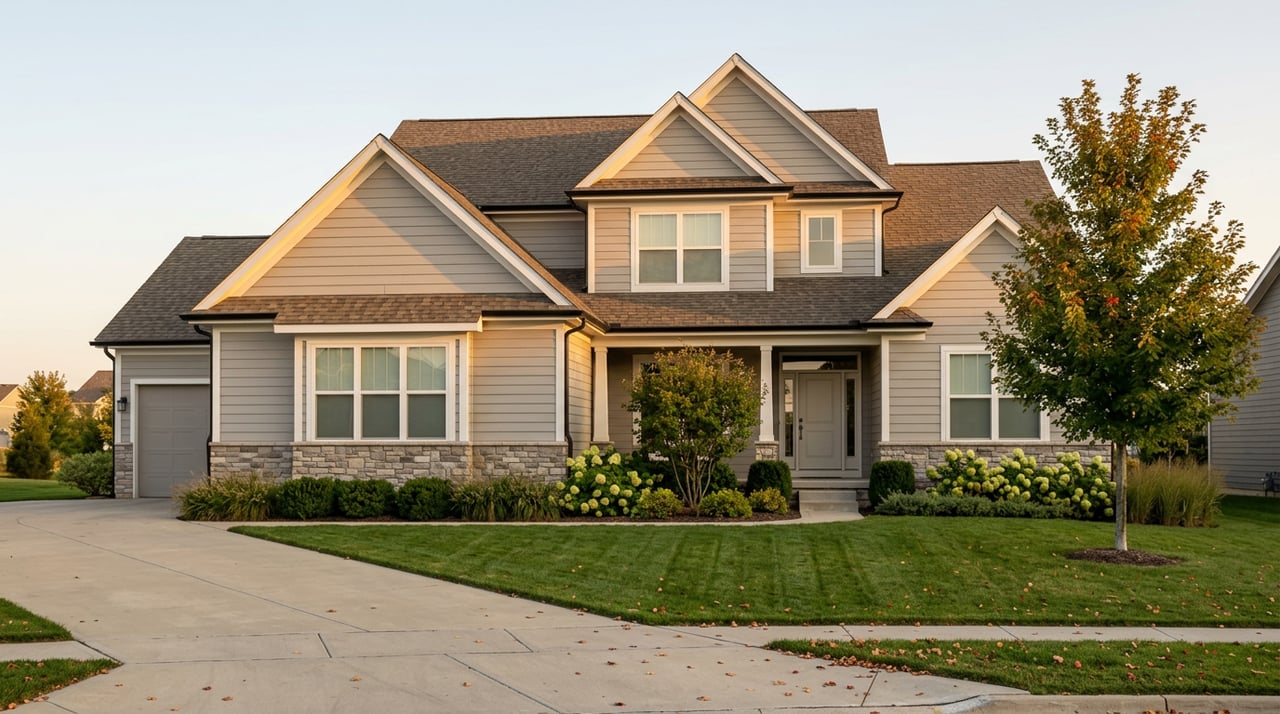
If two houses cost almost the same to buy, why would one cost nearly double to keep?
That is the question a lot of stateline buyers run into once they start cross-shopping in earnest. Pull up a listing in Roscoe, Illinois and a comparable one in Milton, Wisconsin, and the price tags often land within a few thousand dollars of each other. Both towns are currently sitting around the $230,000 to $240,000 mark for a typical single-family home. Same bedroom count, similar square footage, similar age of construction. On the surface, it reads like a coin flip.
Then the mortgage lender runs the escrow analysis, and the monthly payment on the Roscoe house comes in noticeably higher than the one across the border, even though the loan amounts are nearly identical. The gap isn't a lender error. It's the property tax line.
The Portal Number Isn't the Real Number
Most listing sites show an estimated annual tax figure pulled from the last recorded bill, and that estimate can be stale, incomplete, or based on an assessed value that no longer matches the home's current market price. It's a placeholder, not a forecast. For a buyer comparing two states with two entirely different tax structures, treating that number as comparable across the line is where the real confusion starts.
Winnebago County, where Roscoe sits, runs an effective property tax rate that recent assessor-based data puts somewhere between roughly 2.3 and 2.8 percent of market value, depending on the specific parcel and taxing district. Rock County, Wisconsin, where Milton sits, runs closer to 1.2 to 1.4 percent. Apply those ranges to homes of similar value and you get a Roscoe tax bill in the neighborhood of $5,900 to $6,100 a year, against roughly $2,900 to $3,200 a year in Milton. That's not a rounding difference. That's an extra $250 or so a month, every month, for as long as you own the house.
Where Roscoe's Bill Actually Goes
The gap isn't arbitrary and it isn't a sign that Roscoe is mismanaged. It's a function of how many separate taxing bodies draw from the same assessed value. A Roscoe tax bill isn't one levy, it's a composite: school district, county government, township, the village itself, and often a park or fire protection district. In Winnebago County, the largest single share of a typical bill, often 60 to 70 percent, goes directly to the local school district, which makes school levies the biggest lever on the total.
Published assessor data for Roscoe notes that rates are not uniform across the village, a reflection of how school district boundaries and local assessment districts are drawn across Winnebago County. Two homes of similar value can still land on different sides of that boundary map and see different totals on the bill.
What Rock County Does Differently
Wisconsin doesn't run a fundamentally different kind of property tax. Milton homeowners still pay municipal, county, school district, and technical college levies. But the overall reliance on the property tax line is lower, and the state leans more heavily on income tax to fund the difference. That trade-off cuts in interesting directions depending on what a buyer earns.
Illinois charges a flat 4.95 percent state income tax rate regardless of income level. Wisconsin uses a graduated bracket structure that climbs to 7.65 percent at higher incomes. Run the math on a household earning around $50,000 and Wisconsin's income tax bill comes in a few hundred dollars lower than Illinois'. Push the household income up toward $150,000 and the two states swap places, with Illinois's flat rate coming out ahead on income tax alone. The crossover generally lands somewhere in the neighborhood of $90,000 in household income.
What doesn't flip, at any income level, is the property tax gap. A household earning $200,000 still pays roughly double the property tax on a $230,000 home in Roscoe compared to the same home in Milton. Income tax is a seesaw. Property tax, for these two towns, is a one-way street.
| Roscoe, IL (Winnebago County) | Milton, WI (Rock County) | |
|---|---|---|
| Typical home value | ~$230,000–$240,000 | ~$230,000 |
| Effective property tax rate | ~2.3%–2.8% | ~1.2%–1.4% |
| Estimated annual tax bill | ~$5,900–$6,100 | ~$2,900–$3,200 |
| Where the bill mostly goes | Local school district (roughly 60–70% of the total) | Split across municipal, county, school, and technical college levies |
Buyers Are Choosing Roscoe Anyway
None of this has slowed Roscoe down. The village currently has multiple active subdivisions selling new construction, including Denali Heights and Commons at Prairie Hill, both zoned into the Hononegah and Prairie Hill school districts, along with Manchester Trails and Hidden Creek. Builders like Selene Homes and Next Generation Construction have been steadily filling lots in these developments with everything from compact ranch plans to four-bedroom two-stories on wooded half-acre lots.
The village is still adding to that pipeline. In June 2026, Roscoe's Village Board held an informational presentation on a proposed residential planned unit development off McDonald Road and Double Ditch Court, just west of the Roscoe Culver's, with a Zoning Board of Appeals hearing following shortly after. That's a village still working through where its next few hundred rooftops will go, which means the tax base keeps expanding even as individual rates stay elevated relative to the Wisconsin side.
The draw is easy to understand once you look past the tax line. Roscoe sits directly on the I-90 corridor with quick access to Rockford, and its school districts carry strong reputations locally. For a lot of buyers, that combination is worth the higher carrying cost. The point isn't that Roscoe is the wrong choice. It's that the choice should be made with the real number in hand, not the portal's placeholder.
Pull the Parcel, Not the Portal
Before you compare a Roscoe listing to a Wisconsin one, do this instead of trusting the estimated tax field:
- Pull the actual current tax bill for the specific parcel from the Winnebago County Treasurer's records, not a countywide average.
- Ask for the same on the Wisconsin side through Rock County's property records, since mill rates and school levies vary by district there too.
- Check the assessment notice timeline. Winnebago County mails assessment notices each spring, typically reaching mailboxes by mid-July, so a bill you're looking at in September may already reflect a value the county has since revised.
- Add the property tax difference to the mortgage comparison directly, not as a footnote. A $250 monthly gap changes what loan amount actually fits a buyer's budget.
This is exactly the kind of comparison that gets easier with an agent who works both sides of the line regularly and already knows which office to call for a specific parcel's current bill in either county.
A Few Questions Worth Answering Directly
Does a lower tax rate always mean a lower total bill? Not by itself. Rate and home value both matter. A higher-value home in a lower-rate county can still carry a bigger bill than a lower-value home in a higher-rate one. Always run the rate against the specific home's assessed value, not just the county average.
Can a Roscoe homeowner appeal their assessment? Yes. Illinois property owners can file a formal appeal with the Winnebago County Board of Review, generally within 30 calendar days after assessment notices are published, with further appeal available through the state Property Tax Appeal Board if needed. This is a procedural option worth knowing about, not a guarantee of a lower bill, and any homeowner considering it should confirm current deadlines with the county assessor's office.
Is the tax gap the same everywhere in the stateline corridor, or specific to these two towns? Rates vary by county and even by taxing district within a county on both sides of the border. The Roscoe-to-Milton comparison reflects Winnebago County and Rock County specifically. A different Illinois or Wisconsin town in the corridor could carry a different gap entirely, which is exactly why pulling parcel-specific numbers matters more than relying on a general rule.
If you're weighing a move across the stateline corridor and want the real carrying-cost picture before you write an offer on either side, Teresa Skridla works both Illinois and Wisconsin licenses every day and can pull the actual numbers for the specific parcels you're comparing. Request Your Free Home Valuation and get a clear, side by side comparison built on the real tax bill, not the portal's placeholder.